Introduction:
Have you ever misplaced your keys for the third time in a week, watched your dog escape through a hole in the yard, or been stuck at the airport waiting for your luggage while everything else goes by? If so, you’re not alone—millions of people are looking for a solution like the Apple AirTag every day.
But here’s the thing: AirTags aren’t perfect for everyone. They can be really helpful in some situations, but they might also become frustrating at times. In this review, we’ll discuss what AirTags do well, where they might fall short, who might benefit from using one, and when it might be better to choose a traditional GPS tracker instead. Let’s dive in!
Quick Picks: Best AirTag Uses at a Glance
| Use Case | AirTag Suitable? | Better Alternative? |
| Keys & wallet | Excellent | — |
| Luggage tracking | Very good | — |
| Dog collar tracking | Limited | GPS dog tracker |
| Bike anti-theft | Situational | — |
| Vehicle tracking | Partial | Dedicated GPS |
| Real-time location | Not supported | GPS tracker |
What Is an Apple AirTag and How Does It Actually Work?
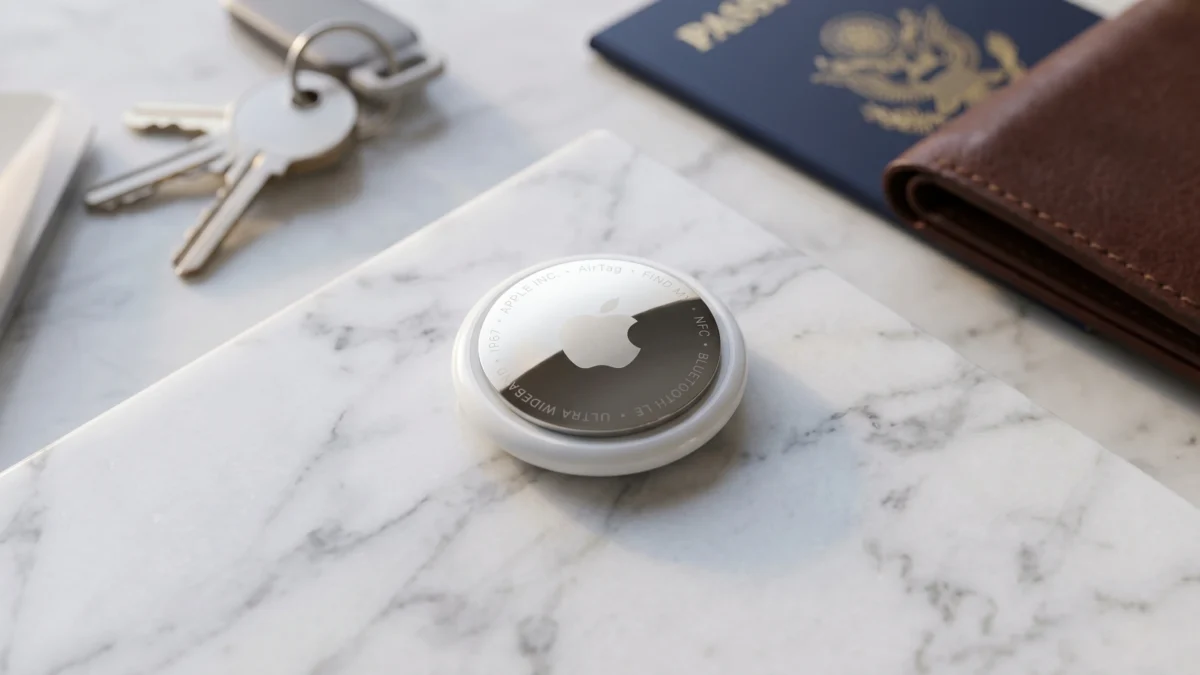
The Apple AirTag is a compact, coin-shaped Bluetooth tracker, roughly the size of a 50-pence piece. It leverages Apple’s extensive Find My network to help users locate misplaced items. The device is priced at approximately $29 per unit or $99 for a pack of four.
The innovative aspect of AirTag technology lies not in Bluetooth itself, but in its ability to leverage Apple’s vast Find My network. This network encompasses over a billion active devices, including iPhones, iPads, and Macs, which anonymously assist in reporting the location of your AirTag back to you. Whenever your AirTag is near these devices, it receives more frequent updates, making its location tracking more efficient and reliable.
Here’s how the process works step by step:
- Your AirTag constantly broadcasts a Bluetooth signal
- Nearby Apple devices pick up the signal and discreetly forward their location to Apple’s servers
- Apple secures this information with end-to-end encryption and sends it directly to your iPhone
- You open the Find My app and see its last known location. You can play a sound or use Precision Finding to go to it.
Precision Finding is a feature in which AirTags demonstrate significant effectiveness. When within Bluetooth range—generally estimated at approximately 30 to 40 feet in unobstructed environments—an iPhone equipped with a U1 chip uses Ultra Wideband technology to display a real-time directional arrow and a distance countdown that guide the user directly to the misplaced item. The accuracy of this functionality is remarkable, prompting one to consider how they managed without it previously.
AirTag Accuracy: How Precise Is the Location Tracking?
This is the most common question — and the answer depends heavily on context.
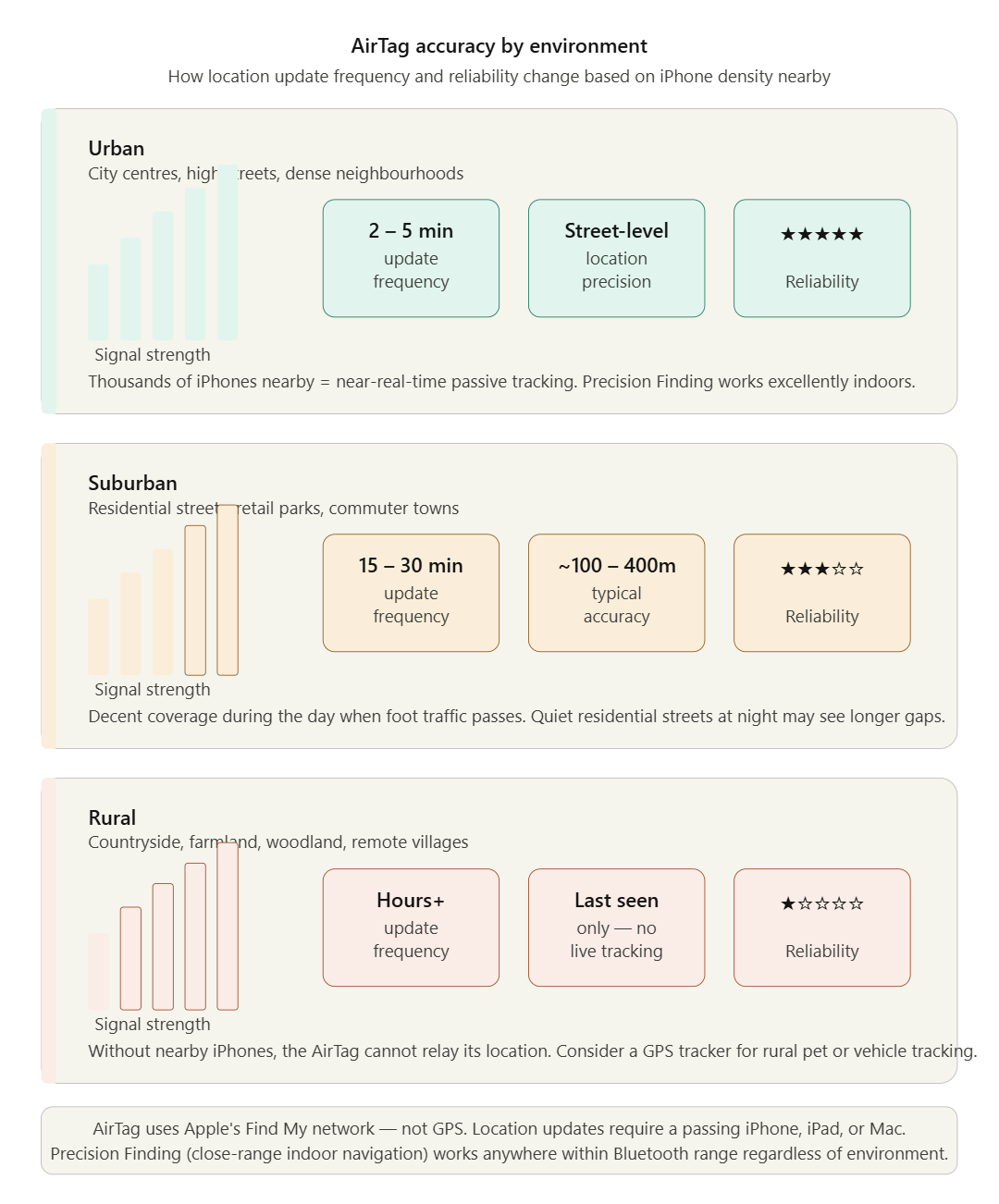
In urban and densely populated suburban regions, AirTags demonstrate a high accuracy. With numerous iPhones frequently passing in proximity, location updates can occur every few minutes. This means users can often pinpoint their belongings to a specific location, such as “at Platform 3 of Manchester Piccadilly,” rather than simply saying they are “near the train station.”
In rural or remote areas, the performance of tracking devices significantly diminishes. If a dog were to venture into woodland areas devoid of iPhone users, the AirTag may only reflect a location from an hour prior. This limitation is not necessarily a defect; rather, it underscores the inherent constraints of crowd-sourced tracking in comparison to real-time GPS capabilities.
Precision Finding in indoor environments is where the AirTag technology demonstrates its true capabilities. If one misplaces keys behind a sofa cushion, the U1 chip provides guidance to within mere inches. Many individuals report this experience as unexpectedly emotional; as one approaches the lost item, haptic feedback intensifies, culminating in the moment the item is located.
The objective assessment of accuracy shows that AirTags are highly effective at tracking the historical locations of items. However, they are not designed as real-time GPS trackers and should not be misconstrued as such for immediate location tracking.
Apple AirTag for Dogs: What You Need to Know Before You Buy
This is probably the most searched topic in this entire review — and the most misunderstood.
Can you use an AirTag on a dog collar? Yes. Should you rely on it as your primary dog tracker? Probably not — and here’s why.
How Apple AirTag Work on Dogs
Attaching an AirTag to a dog’s collar is a straightforward process. Numerous accessories are available, including AirTag dog collar holders, silicone loops, and specially designed collar attachments, priced from £5 to £25. The AirTag is designed to be water-resistant to IP67 standards, ensuring it can withstand exposure to rain, puddles, and occasional immersion without compromising functionality.
When a dog strays from its designated area, the Apple AirTag provides its location by leveraging signals from nearby iPhones, similarly to the tracking of any other item. In a suburban environment with moderate foot traffic, this method proves fairly effective for locating a missing dog. Often, it allows the owner to identify the street or park where the dog has been seen.
Where It Falls Short for Dogs
A significant limitation of this technology is the absence of real-time tracking capabilities. When a dog is in motion, the user does not receive a live update displaying the dog’s location on a map. Instead, the data reflects the last recorded position of the AirTag, which is determined by the most recent interaction with an iPhone in proximity.
For a dog exhibiting anxiety and a tendency to bolt, the interval between location-tracking updates could be as long as 20 minutes, allowing the dog to cover considerable distance within that timeframe. In a tranquil rural environment, this interval might last several hours.
AirTag vs GPS Tracker for Dogs — the key differences:
| Feature | Apple AirTag | GPS Dog Tracker (e.g., Tractive, Fi) |
| Real-time tracking | No | Yes |
| Works without iPhones nearby | No | Yes |
| Monthly subscription | None | Required ($5–$15/mo) |
| Battery life | ~1 year | Days to weeks |
| Water resistance | IP67 | Varies |
| Precision Finding | Yes | No |
| Best for | Found dog recovery | Active tracking |
The conclusion is as follows: An AirTag serves as a valuable supplementary tool for dog owners, particularly effective for locating a nearby, stationary dog and advantageous for recovery when a conscientious individual with an iPhone is in proximity. However, for dogs considered escape artists or for owners in rural areas, investing in a dedicated GPS dog tracker, despite the associated subscription costs, is a prudent decision.

AirTags for Travel: Luggage, Airports, and Peace of Mind
This is truly among the smartest ways to use an AirTag, and tons of travelers rely on them.
Place one device inside your checked luggage, laptop bag, or camera case. Upon arrival, rather than waiting at baggage claim with uncertainty about your bag’s status, you can use the Find My app to locate it. Information such as “Still at Heathrow” is valuable, while “Just left the carousel area” is even more insightful.
Real-World Travel Scenarios Where AirTags Shine
If your luggage gets delayed, it can be super frustrating! While airlines have their own tracking systems, having an AirTag gives you a little extra peace of mind. If your bag takes a wrong turn and ends up in a different city, you’ll know right away instead of waiting around for the airline to figure it out. It’s a simple way to stay in the loop!
If you’ve left your bag in the hotel lobby or your jacket on the plane, no worries! As long as your iPhone was close by, the Find My app will still show you the last place it was spotted.
In the context of theft occurring in densely populated urban areas, it is important to note that while an AirTag may not facilitate real-time GPS tracking of a stolen bag or wallet, it does provide law enforcement with the last known location, which can be sufficiently precise to enable appropriate action.
Just a quick tip: these days, many airports are buzzing with iPhone traffic, which means your AirTags can update in almost real-time while you’re in the terminal! We’ve noticed that at major international airports, bags can refresh every 2-3 minutes. How cool is that?
AirTag for Bikes and Vehicles: Anti-Theft Use Cases
AirTag for Bikes
Cyclists are increasingly adopting AirTags for tracking, prompting manufacturers to develop innovative mounting solutions. These include stem caps, seat post inserts, and handlebar plugs designed to securely conceal the AirTag from plain sight, enhancing both security and aesthetics.
If your bike is stolen and taken through an area with iPhone traffic, there’s a real chance of recovering it. Several well-documented cases exist of bikes being recovered within hours thanks to AirTag location data shared with police.
A crucial consideration: AirTags should not be relied upon as comprehensive anti-theft solutions. A determined thief can disable an AirTag if discovered, though Apple has implemented measures to make this action more difficult over time. Furthermore, if the stolen bike is located in an area devoid of nearby iPhones, the tracking functionality ceases. Thus, these devices are most effective when utilized as part of a multifaceted security strategy that includes a robust locking mechanism, registration of the bike’s serial number, insurance coverage, and the AirTag serving as a discreet tracking option.
AirTags for Vehicle Tracking
Users employ AirTags discreetly placed in vehicles, such as cars, motorcycles, and caravans, to leverage the extensive reach of the Find My network. In urban settings with high-density connectivity, these devices enable real-time tracking of stolen vehicles as they navigate through traffic, facilitating recovery efforts.
However, it’s worth knowing that some jurisdictions have specific rules about vehicle tracking devices, particularly if tracking a vehicle you don’t own. Always check local regulations.
AirTag Design, Battery, and Practical Details
Design and Build
The AirTag features a refined design, measuring approximately 31.9mm in diameter and 8mm in thickness, allowing for inconspicuous carry while maintaining durability for everyday use. The rear features a polished stainless steel surface, which, while susceptible to fingerprints, demonstrates commendable abrasion resistance. The front is constructed from minimalist white plastic, ensuring a low-profile aesthetic that seamlessly integrates into various environments.
One thing to keep in mind is that it doesn’t come with a built-in attachment point. You’ll need a separate holder or keyring accessory to connect it to your belongings. Apple offers some nice options (starting at around $29 for a simple loop and going up to $49 for leather), but there are also plenty of great third-party alternatives available that are more budget-friendly!
Battery Life and Charging
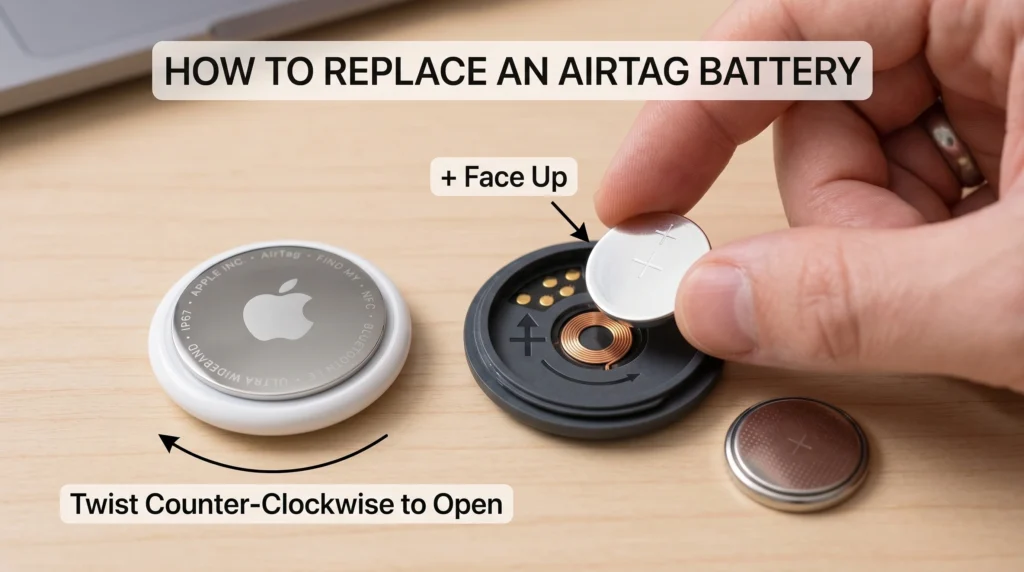
AirTags are powered by a CR2032 coin cell battery, a common type utilized in wristwatches and key fobs. Apple estimates a lifespan of around one year under typical usage conditions, a figure that aligns with real-world experiences reported by the majority of users.
Replacing it is as easy as a simple twist of the back cover—no tools or charging cables needed. You’ll receive a low battery notification in the Find My app before it runs out. This is the essence of brilliant design: no proprietary charging, no worries about battery degradation, and replacement batteries are remarkably affordable.
Are AirTags Magnetic?
AirTags are not inherently magnetic, so they do not adhere to metal surfaces on their own. For magnetic mounting options, users must use specially designed magnetic cases or holders engineered for AirTags. These accessories are effective for applications such as automotive mounts or securing in toolboxes, providing a reliable solution for those seeking to attach AirTags magnetically.
AirTag Accessories Worth Considering
The AirTag ecosystem of accessories has exploded since launch. Here are the categories worth knowing about:
A growing selection of iPhone cases now features a built-in compartment for an AirTag on the rear surface. This innovation is particularly beneficial for individuals who frequently misplace their devices and seek to consolidate tracking solutions in a single location.
AirTag lock cases: Robust, tamper-resistant enclosures designed to enhance the security of AirTags by complicating their removal or disablement. These cases are especially favored in applications involving bicycles and vehicles, where theft is a significant concern.
When it comes to AirTag dog collar holders, you’ll find some great options like silicone loops and sturdy cases that fit snugly on most standard collar widths. Just be sure to check for models rated IP67 or higher to match the AirTag’s water resistance. Happy tracking!
AirTag-compatible wallets, including slim cardholders and bifold designs, have emerged on the market, integrating dedicated compartments specifically for AirTags. This development effectively addresses the challenge of securely attaching tracking devices within wallet structures, providing a seamless solution for enhanced wallet tracking and retrieval.
Pros and Cons of the Apple AirTag
What we genuinely like:
- Precision Finding is impressively accurate indoors
- No monthly subscription required
- One-year battery life with standard CR2032 cells
- Dense Find My network in cities and suburbs
- Water-resistant and durable
- Simple setup (one tap on a compatible iPhone)
What we’d improve:
- No real-time tracking — location depends on nearby iPhones
- Requires an iPhone (no Android support)
- No built-in attachment loop
- Limited utility in rural or low-iPhone-traffic areas
- Anti-stalking alerts, while important, can occasionally flag legitimate tracking
FAQ: Apple AirTag Questions People Actually Ask
How far do AirTags work? AirTags do not have a fixed range. They use Apple’s Find My network, which enables any iPhone to transmit its location globally. In practical terms, AirTags are most effective in environments with consistent iPhone usage. The Precision Finding feature, which facilitates close-range navigation, operates effectively within approximately 10 meters of the user’s iPhone.
Are AirTags worth it for dog tracking? Partially. They’re genuinely useful for locating a stationary or slow-moving dog in a suburban area, and the no-subscription model is appealing. But for active, real-time tracking of a dog that could be running fast through rural terrain, a dedicated GPS dog tracker offers far more reliability. Many dog owners use both.
How accurate are AirTags compared to GPS trackers? For crowd-sourced passive tracking, AirTags are accurate to within a specific street address in populated areas. For Precision Finding within Bluetooth range, they’re accurate to within centimeters. GPS trackers offer real-time location tracking anywhere there’s a cellular signal, but they typically require monthly fees and have shorter battery life.
Can you charge an AirTag? No — AirTags aren’t rechargeable. They run on a standard CR2032 coin battery, which typically lasts about a year. Replacement takes about 30 seconds and costs very little.
Do AirTags work without Wi-Fi or cellular? Yes and no. AirTags themselves don’t need Wi-Fi or cellular — they use Bluetooth. But location updates are relayed through the iPhones of nearby strangers, who need cellular or Wi-Fi to transmit the signal. If there are no iPhones around, the AirTag can’t update its location.
The Verdict: Should You Buy an Apple AirTag?
For iPhone users who frequently misplace items such as keys, use checked luggage when traveling, require a low-maintenance security solution for bicycles or vehicles, or seek a no-subscription attachment tracker for everyday use, the AirTag is a compelling option. Its functionality aligns seamlessly with its design goals; it delivers precise tracking capabilities through Apple’s Find My network with impressive accuracy. Furthermore, the absence of a recurring subscription fee enhances its long-term cost-effectiveness, making it a practical tool for integrated item management.
For situations requiring real-time tracking, such as monitoring a dog, a vehicle in a remote area, or any scenario where live location data is crucial, the AirTag may not be the most suitable option. In these cases, it’s advisable to utilize a dedicated GPS tracker specifically designed for real-time location tracking.
The AirTag should be regarded not as a GPS tracker, but as a highly advanced tool designed to provide “last seen here” information. When viewed through this lens, it offers excellent value and stands out as one of Apple’s most effectively utilitarian products.
Next step: If you’re purchasing for a dog, elevate your choice by pairing the AirTag with a durable collar holder designed for outdoor adventures. If you’re gearing up for travel, opt for a sleek luggage loop to keep your bag secure and quiet. And if you find yourself contemplating the best option between GPS and AirTag for your pets, our comprehensive comparison guide delves into the top choices tailored for various breeds, lifestyles, and budgets.